
The Australian Academy of Health and Medical Sciences has released a landmark ten-year roadmap to advance equity and leadership representation for women across the nation’s health and medical sciences (HMS) ecosystem.
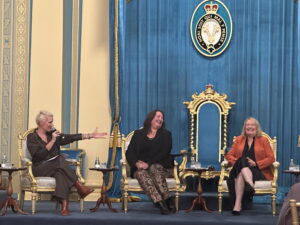
Women in the Health and Medical Sciences: Decadal Plan outlines a system-wide strategy to dismantle barriers, improve leadership pathways and embed accountability across the sector. The Plan was officially launched by Assistant Minister for Health and Aged Care, the Hon. Rebecca White MP, at the Australian Academy of Health and Medical Sciences Annual Gala Dinner in Canberra on 29 October 2025.
Prof Helena Teede AM, Director of MCHRI, chaired the Expert Advisory Group and the contribution of the evidence generated in the Monash University, MCHRI-led Advancing Women in Healthcare Leadership initiative, with Dr Wafa El-Adhami, Thuy Vy Nguyen
Despite women making up 52% of the Australian health and medical research workforce, they account for only around one in four of the most senior positions. This underrepresentation persists across universities, medical research institutes and health environments.
While other sectors have seen substantial progress through targeted policies and investment – moving Australia’s overall gender equality ranking from 70th in 2021 to 13th in 2024 according to the World Economic Forum, the health and medical sciences have been largely absent from national STEM gender equity strategies, but face quite particular challenges.
The Decadal Plan identifies five key strategic opportunities for change:
- Building a coordinated national policy environment for gender equity in health and medical research;
- Ensuring fair and equitable funding structures;
- Developing a national workforce strategy and data framework;
- Driving organisational change for safe, inclusive and equitable workplaces; and
- Establishing enduring mechanisms for implementation, monitoring and accountability.
Drawing on evidence from across health, academia, government and industry, the Decadal Plan outlines an integrated framework for reform to embed evidence, continuous learning and systems change.
“Women are integral to every advance in health and medical science — as clinicians, researchers, educators and leaders — yet their full potential remains constrained by persistent structural and cultural inequities,” said Professor Louise Baur AM PresAHMS, President of the Australian Academy of Health and Medical Sciences.
“This Plan provides a blueprint for change. It sets a clear path toward a sector that not only values equity as a moral imperative, but recognises it as essential to excellence, innovation, and impact.”
The Decadal Plan highlights long-standing disparities in funding and progression. Between 2019 and 2021, male applicants for National Health and Medical Research Council Investigator Grants received 35% more grants and 67% more total funding than women – around $95 million more each year. Instituting structural policy change has delivered rapid, measurable change with equity since 2023.
Similarly, women in later career stages remain underrepresented in grant applications to the Medical Research Future Fund despite having higher success rates — a signal of systemic attrition and senior under-representation.
“Unlike other areas of STEM, health and medical research has been largely overlooked in gender equity policy and investment.[1] The evidence is clear – equity is not just about fairness, it drives innovation and research equity, and hence informs and drives equity in healthcare and health outcomes” said Professor Helena Teede FAHMS, Academy Fellow and Council Member, and Chair of the Decadal Plan Expert Advisory Group.
“This Decadal Plan sets out a practical, evidence-based roadmap for achieving systemic and cultural change across funding, leadership, organisational change and accountability. If implemented in full, it can reshape the sector for generations to come.”
The Decadal Plan also calls for a National Taskforce for Advancing Gender Equity in Health and Medical Sciences to coordinate reform, strengthen accountability and monitor sector-wide progress. It recommends regular evaluation cycles and a national data framework to track gender equity outcomes across research, health and policy environments.
“Drawing on evidence from successful initiatives – and evidence from international research – the Plan underscores the value of structured leadership development, mentoring and connecting women, in driving equity. To help embed these principles nationally, the Academy is seeking to work in partnership with Government and other stakeholders to deliver initiatives that support and connect emerging women leaders with Australia’s most eminent health and medical leaders, including AAHMS Fellows – harness the Academy’s unparalleled convening power to strengthen pathways into senior leadership across research, health and policy domains”, said Professor Baur.
Evaluations of such programs show measurable impacts, including up to 95% promotion success rates among participants and substantial increases in leadership confidence and retention.
“The success of this Plan will depend on collective effort,” said Professor Teede.
“Every part of the system — from funding bodies to universities, health services, and government — has a role to play in ensuring that equity is embedded not at the margins, but at the core of how we do science and deliver healthcare in Australia.”
Developed through more than 12 months of consultation with government agencies, universities, medical research institutes, professional bodies and other stakeholders, the Plan reflects input from more than 30 organisations and 31 senior leaders across the sector.
This media release was originally published on the AAHMS website and has been published here with permission.
Contact: Amanda Hamilton
Monash Centre for Health Research and Implementation (MCHRI)
T: +613 8572 2667, amanda.hamilton@monash.edu